
Lessons Learned in Narrative Mainstreaming for Non-Profit Campaigns: Practical Insights from the Field

Working with non-profits has taught me a lot about the challenges of getting important issues noticed and talked about. At Commcap, we’ve had the privilege of helping organizations navigate these obstacles and find effective ways to share their messages. Here’s a look at what we’ve learned through hands-on experience.
The Challenges Non-Profits Faced
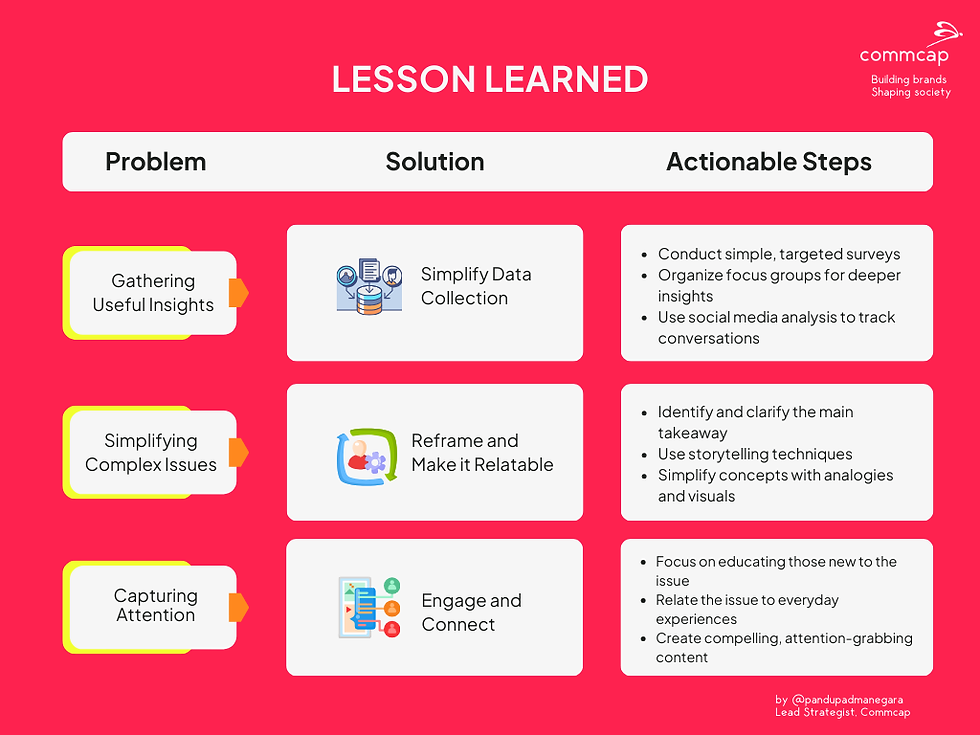
1. Gathering Useful Insights
Understanding your audience is the first step in any campaign. However, figuring out what people know and how they feel about an issue can be challenging for non-profits. Digging deep into audience insights can feel overwhelming with limited time and resources.
2. Simplifying Complex Issues
One of the biggest challenges in issue-based campaigns is taking a complex problem and making it easy for everyone to understand. Non-profits often deal with nuanced and multifaceted topics, but the key to a successful campaign is breaking these issues down into simple, relatable messages. However, this is easier said than done, especially when we want to do justice to the complexity without overwhelming our audience.
3. Capturing Attention
The digital world is noisy. Competing with other messages, especially when there are groups pushing against our narrative, can make it hard to be heard. Getting people to pay attention to our cause isn’t easy when so many other voices are out there.
4. Working with Limited Resources
Nonprofits often work with small budgets and teams, making planning and executing extensive campaigns difficult. We have to make every Rp or $$ and every minute count.
5. Creating a Practical Plan
It’s one thing to come up with a big idea, but making it work with the resources we have is another story. We often had to balance what we wanted to do with what was possible.
6. Breaking Out of the Echo Chamber
Social media can trap people in their bubbles, where they only see content that matches their existing views. For a campaign to succeed, it must reach beyond these bubbles and connect with new audiences.
7. Measuring Outcome & Impact
Figuring out if a campaign is working can take time and effort. Non-profits need to know if their efforts are paying off, but finding the right measure of success isn’t always straightforward.
What We Learned and How We Overcame These Challenges
1. Keeping Track of the Narrative
Combining simple surveys, focus group discussions, and analyzing social media conversations helped us understand what people said about the issues. These tools weren’t expensive or complicated, but they gave us the insights to keep our campaigns on track.
2. Simplifying Complex Issues
We found that the best way to simplify complex issues was to start by identifying the core message—what is the one thing you want your audience to understand and remember? From there, we used storytelling techniques to make the issue relatable and human. Instead of overwhelming people with data and jargon, we focused on telling stories that connected the issue to everyday experiences. Visual aids, analogies, and real-life examples were also incredibly helpful in making the problem more accessible.
3. Getting Target Audience’s Attention
To capture their interest, we focused on developing a relatable hook that would draw them in. We made the issue feel relevant and urgent by personalizing the problem and highlighting the pain points in a way that resonates with their everyday experiences.
We also concentrated on creating content at the top of the funnel, explicitly targeting those new to the issue. By doing so, we could start a meaningful conversation that gradually engages and informs them, making them more likely to become involved in the cause.
4. Making the Most of Limited Resources
We got creative with our content by breaking down larger pieces into smaller, bite-sized chunks that could be used across different platforms. We also collaborated with other organizations and used collaborative and automated content production tools to produce content quickly and efficiently. It wasn’t about having more; it was about using what we had smarter.
5. Planning That Works
Instead of trying to do everything at once, we focused on smaller, more manageable goals that could make a real impact. We linked these efforts to key events or moments when people were already paying attention to the issue, ensuring our efforts were realistic and practical.
6. Reaching Beyond the Bubble
One of our most successful strategies was working with communities and other groups with similar values. By teaming up with different voices, we could break through the algorithms that keep people in their bubbles and reach a wider audience.
7. Measuring and Learning
We kept things simple by focusing on just a couple of key metrics to measure the success of our campaigns. Whether it was how people felt about the issue or the direct results of our work, these metrics helped us see what was working and what wasn’t. We also improved by developing capacity-building activities for the Commcap team and campaign partners.
Working in non-profit campaigns is challenging, but it’s also enriching. We’ve learned that a focused and practical approach can make a big difference, even with limited resources. I hope that by sharing them, other non-profits can find new ways to tackle their challenges and continue making an impact.
If you have any thoughts or experiences to share, I’d love to hear them.


Comments